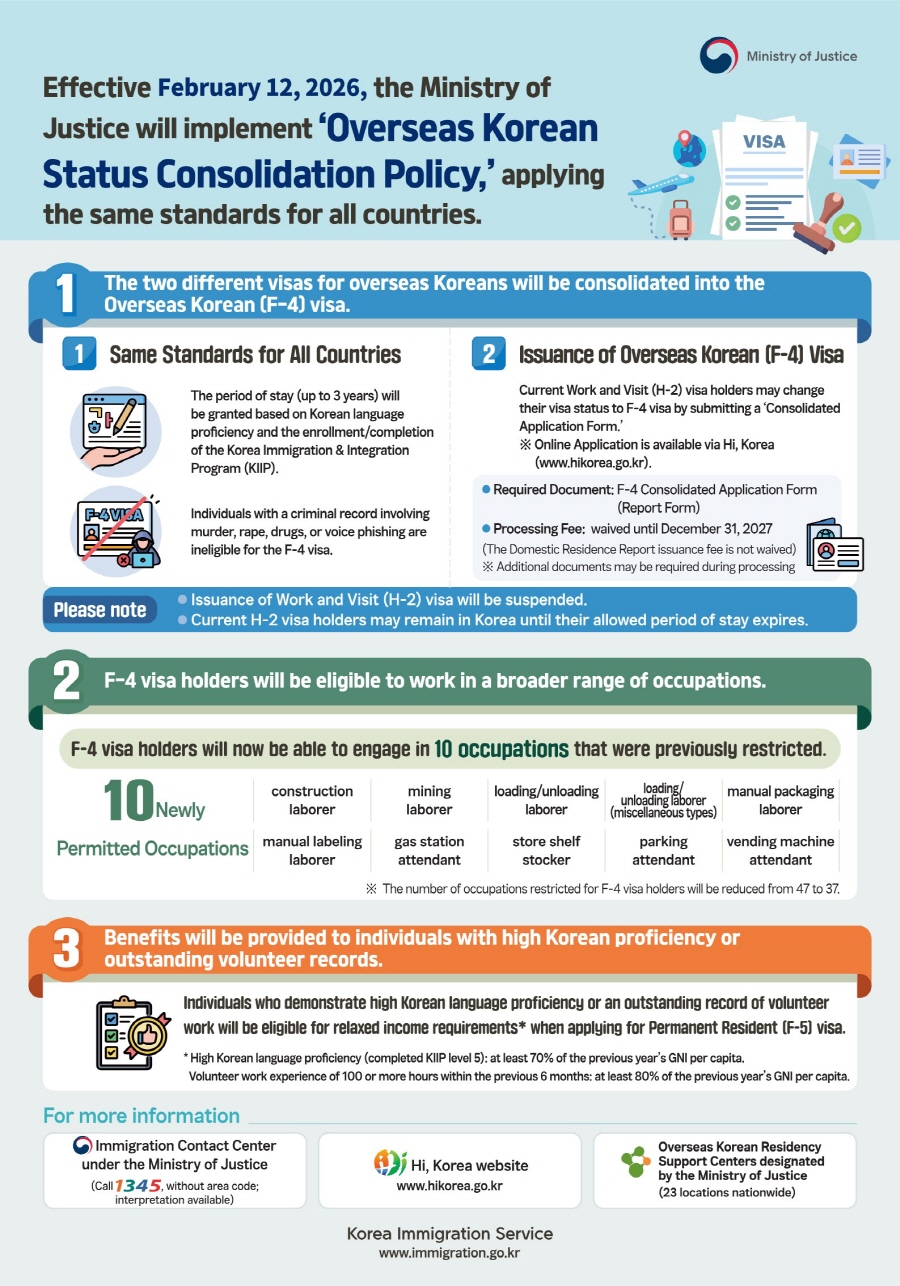
In early 2026, South Korea’s Ministry of Justice announced the Overseas Korean Status Consolidation Policy, a major revision of how visas for ethnic Koreans abroad are issued and administered. Under this policy, two existing categories of overseas Korean residence visas will be merged into a single Overseas Korean (F-4) visa, with standardized issuance criteria across countries.
This change signals the government’s effort to simplify complex visa rules—but it also underscores how layered and controversial visa and citizenship status can be for people with Korean roots.
Why Different Visas? Historical Background
In many countries, being “Korean” might simply mean holding a Korean passport. But for many overseas Koreans—often called 동포 (Dongpo), 교포 (Gyopo), 조선족 (Joseonjok), 고려인 (Koryoin) and more—that identity is far more complicated. As we explore below, the Korean visa and citizenship system reflects history, geopolitics, military requirements, and societal debate.
To understand why Korea has distinct visa types for ethnic Koreans rather than simply granting citizenship, we must look at migration history. From the late 19th century through the 20th century, many Koreans emigrated under Japanese colonial rule, famine, and later geopolitical strife. Communities of ethnic Koreans established themselves in China, Russia, Japan, and elsewhere, often losing or renouncing nationality along the way.
Over decades, Korea created visa categories like H-2 and F-4 to accommodate these diasporic populations, allowing legal sojourn and labor rights based on ethnic connection even without formal citizenship.
Visa Types for Korean Roots and Abroad
South Korea’s immigration framework recognizes a range of statuses for non-national Koreans, intended to facilitate their entry and residence while distinguishing them from ordinary foreign nationals.
At the core is the Overseas Korean (F-4) visa, previously granted to foreign nationals of Korean descent who once held Korean nationality or whose parents did. F-4 has traditionally allowed long-stay residence and work, though with some restrictions on occupations and rights compared to full citizens. Under the new 2026 policy, F-4 becomes the unified category for ethnic Koreans abroad, replacing overlapping systems such as the older Work & Visit (H-2) visa. Applicants with high Korean language skills and evidence of integration may also receive eased requirements for future permanent residency (F-5).
These visas do not confer citizenship. They grant eligibility for longer stay, work permission, and in many cases access to benefits such as education and healthcare—but not political rights like voting, a privilege reserved for Korean nationals.
Koreans Abroad Visa Types & Key Features
- F-4 Visa (Overseas Korean Visa): Long-term, multiple-entry visa for former Korean nationals and their descendants; allows residence and broad work rights in Korea.
- H-2 Visa (Work & Visit) (being phased out): Previously for certain ethnic Koreans (e.g., from China/former USSR) to live and work under limited conditions.
- F-5 Visa (Permanent Resident): Pathway to permanent residency; incentives for language ability or volunteer service under new policy.
- F-4 Sub-types: Includes categories like descendants, university graduates, executives, or teachers based on specific qualifications.
Korea’s Unique Security and Citizenship Condition
Korea’s complicated relationship with citizenship also stems from its geopolitical situation. Because the Korean War never formally concluded with a peace treaty, and the peninsula remains technically at war, national identity and security concerns carry strong legal weight. One consequence is Korea’s historical reluctance to allow dual citizenship except in narrowly defined cases.
Another distinctive aspect of Korean citizenship policy is mandatory military service for males. All male Korean citizens between roughly ages 18 and 35 must complete compulsory military duty. For many ethnic Koreans considering naturalization, this requirement remains a formidable threshold: acquiring citizenship carries the obligation to serve, a responsibility that significantly influences personal and legal decisions around nationality.

Source : 대한민국 국군 Republic of Korea Armed Forces
Social Controversies Around Visa and Citizenship
The complexity and strictness of Korea’s system have sparked public debate and legal conflict. One of the most prominent cases in recent decades involved K-pop singer Yoo Seung-jun (Steve Yoo). In 2002, Yoo—then a popular idol—publicly promised to fulfill military duty but instead gained U.S. citizenship, leading the Korean government to deny him re-entry and residency status. As a result, he was effectively barred from entering South Korea for nearly two decades.
More recently, Korean courts have ruled the government’s visa refusal to Yoo unlawful, emphasizing constitutional rights over political sentiment. However, the case remains socially polarizing, with many Koreans opposing his re-entry due to draft evasion perceptions.
Another issue appears when people with criminal records or legal infractions seek citizenship or extended visas. For example, recent social posts highlight cases where individuals failed to qualify for citizenship due to serious criminal records—illustrating how legal history can influence nationality outcomes in ways that are non-intuitive to outsiders.
Government Stance and Policy Direction
The Korean government acknowledges the need to balance historical complexities with practical immigration realities. The 2026 Overseas Korean Status Consolidation Policy illustrates a shift toward simplification and expanded rights for ethnic Koreans abroad, addressing long-standing confusion about overlapping visa categories and unequal standards across countries. By consolidating older systems into the modern F-4 visa and expanding allowable occupations, Korean Government aims to make staying and working in Korea more accessible for ethnic Koreans while maintaining public order and security.
Meanwhile, nationality law continues to evolve on matters of dual citizenship, naturalization requirements, and pathways to permanent residency. Courts have sometimes intervened to challenge governmental restrictions, signaling that legal frameworks may be adjusted in the future.
Yet strict military service rules and historical sensitivity around draft evasion remain deeply embedded in the social contract of Korean citizenship, shaping debates about fairness and national identity.
Overseas Korean Status Consolidation Policy – Key Points(2026 update)
- What it is: A 2026 policy merging the Work & Visit(H-2) and Overseas Korean(F-4) visas into one unified F-4 system.
- No new H-2 visas: Issuance of the H-2 visa is suspended; H-2 holders can switch to F-4 status before expiry.
- Expanded work access: F-4 holders can work in more occupations, including some manual labor sectors previously restricted.
- Stay flexibility: Visa durations (1–3 years) may be adjusted based on Korean language ability and integration program completion.
- Integration incentives: Strong language skills and volunteer service can ease permanent residency (F-5) requirements.
South Korea’s visa and citizenship landscape for Koreans with roots abroad reflects the country’s unique history, security concerns, and evolving policy. Understanding this complexity—especially in light of recent consolidation efforts and high-profile legal controversies—helps explain why ethnic Koreans often face differentiated treatment even when deeply connected to Korean culture.